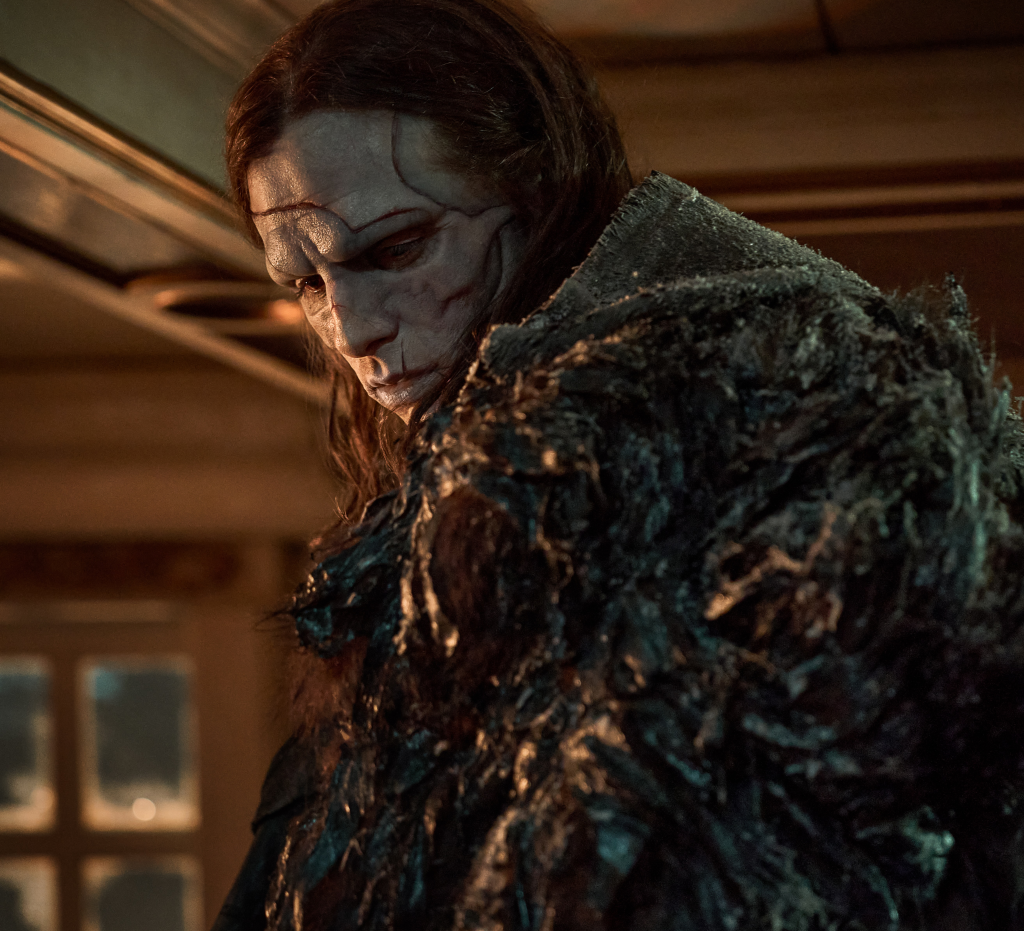


What makes del Toro so uniquely suited to direct Mary Shelley’s creation myth is that he treats monsters the way she did—seriously, emotionally, as reflections rather than aberrations. Shelley’s novel was written by a literal teenager who had already lived more life and grief than most men double her age; she understood the violence of creation, the loneliness of genius, the unbearable intimacy between maker and made. And del Toro, who has spent the past three decades turning monsters into metaphors for childhood, for parenthood, for faith and exile and shame, finally gets to meet her on her own terrain.
Victor’s mother’s look is aggressively continental, almost Germanic, which is so much closer to Mary Shelley’s original Gothic than anything British. The black–and–white servant headdresses in her scenes nod to Prussian and Swiss regional dress, and suddenly you realize Hawley is not referencing Dickens at all; she’s referencing Appenzell lace caps and Schwalm folk veils, those stiff, architectural shapes that sit somewhere between Catholic ritual and rural craft. Victor’s mother ends up dressed like a woman who lived on the exact hinge between aristocratic hauteur and the new machine age. Her silhouette is peak–1850s dome—perfectly circular, mathematically engineered—with the kind of crisp structural underpinnings that only became possible once steel replaced whalebone. She’s the embodiment of the old world trying to hold its spine while industrialization whispers right behind her shoulder.
And honestly, del Toro’s Victor is almost exactly the way I imagined him at fourteen when I first read the book: pathetic, manic, absolutely convinced he’s a visionary because he read two philosophers and no one has told him to shut up yet. This is a Victor who thinks Elizabeth—his baby brother’s literal fiancée—must be madly in love with him because she likes insects and natural philosophy. It’s exactly like 500 Days of Summer’s “Just because she likes the same bizarro crap you do doesn’t mean she’s your soulmate,” except somehow worse, because Victor takes this delusion and builds an entire yearning cosmology out of it. Victor Frankenstein is the prototype of the mediocre man who mistakes shared interests for divine romantic destiny